


Artificial intelligence has evolved from hype to measurable leverage in digital commerce. According to a KfW study from February 2026 , 20 percent of SMEs in Germany now use AI in their day-to-day business – this corresponds to almost 780,000 companies. Blackbit digital Commerce, a commerce engineering agency from Göttingen, supports retailers in the DACH region in using these technologies profitably – with a focus on Shopware, Pimcore and a structured growth framework, the Digital Commerce Performance Roadmap (DCPR).
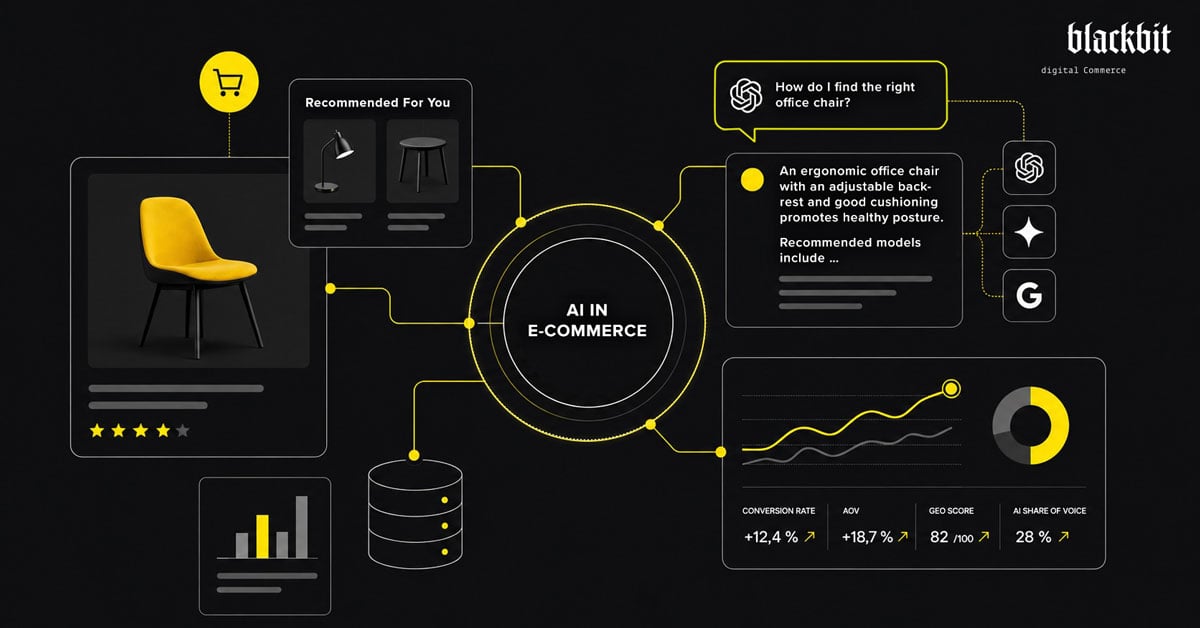
The most important facts in brief: Artificial intelligence delivers measurable results in three fields in e-commerce 2026: AI-supported product recommendations, automated content creation and visibility in generative AI search systems (ChatGPT, Perplexity, Google AI Overviews). According to the KfW SME Panel (Focus on Economics No. 533, February 11, 2026), 20% of SMEs in Germany already use AI – a five-fold increase in six years. Those who take a systematic approach to getting started – with clearly prioritized use cases, clean product data and a defined KPI set – will achieve verifiable effects on conversion rates, shopping basket value and AI visibility within just a few months. Blackbit digital Commerce uses the Digital Commerce Performance Roadmap (DCPR), a management framework with 13 AI KPIs for DACH SMEs.
This article answers the key questions that managing directors, IT managers and heads of e-commerce will be asking in 2026: Which AI use cases actually work? Which KPIs are relevant? And how can you get started without getting bogged down in technology initiatives?
Key Takeaways: AI in E-Commerce 2026 in Five Points
- Product recommendations with AI increase shopping basket values and conversion rates through personalized suggestions in real time – Blackbit customer projects in the DACH midmarket result in conversion uplifts of between 5 and 20 percent compared to static recommendation rules.
- Automated content creation reduces the time-to-content by 30 to 50 percent (experience from Blackbit customer projects) and ensures consistent product texts across the entire range.
- Visibility in ChatGPT, Perplexity and Google AI Overviews will become a decisive competitive factor in 2026 – measured via GEO Score and AI Share of Voice.
- Blackbit's Digital Commerce Performance Roadmap (DCPR) combines classic e-commerce KPIs with 13 AI-specific key figures and makes the use of AI systematically controllable for SMEs in Germany, Austria and Switzerland.
- The quickest way to get started is via a clearly defined use case with defined KPIs – not via broad technology initiatives.
What Does AI in Retail Mean in Concrete Terms?
AI in retail refers to the use of machine learning and language models to analyze data, generate content and automate decisions – along the entire customer journey from the initial search impulse to the repeat order. A distinction can be made between two types of technology:
Predictive AI analyses historical data and recognizes patterns in purchasing behaviour. This results in forecasts for demand, returns, churn risks or optimal price points. Typical applications include demand forecasts, dynamic prices and recommendation models.
Generative AI creates new content – product descriptions, images, translations or personalized campaigns – based on existing information and language models such as GPT-4o, Claude or Gemini.
The main difference to classic algorithms: AI learns independently from data and recognizes correlations that humans often overlook. Both technologies complement each other in practice – a product detail page can simultaneously use generative AI for the description and predictive AI for the cross-selling logic.
How Does the DCPR Structure the Use of AI in E-Commerce?
The Digital Commerce Performance Roadmap (DCPR) is Blackbit's proprietary management tool for the continuous development of digital commerce platforms after go-live – developed in 2023, expanded in 2025/2026 to include 13 AI-specific KPIs. It solves the typical post-launch problem: growing backlogs, diverging priorities and short-term actionism instead of strategic action.
The DCPR breaks down continuous platform development into three consecutive themes – Launch & Harvest, Optimization and Expansion – each with three focus areas. Each focus area has a focus KPI and a defined set of methods and tools. The 13 AI KPIs make AI visibility, AI adoption and AI-driven conversion effects measurable.
In practice, this means that if a retailer wants to introduce AI product recommendations, the DCPR assigns the measure to the focus CRO (Conversion Rate Optimization) , defines the personalization uplift in percent as the focus KPI and defines the baseline, target value and measurement frequency. This turns a tool idea into a controllable project with demonstrable business value.
How Do AI-Supported Product Recommendations Increase Sales?
AI-supported product recommendations increase sales through higher shopping basket values and targeted cross-selling. Blackbit customer projects in the DACH SME sector have resulted in conversion uplifts of between 5 and 20 percent compared to static recommendation rules – depending on product range size, available database and depth of personalization. The technology analyzes purchase history, click behavior and search queries in real time and shows all visitors individually matching articles.
The technology combines two methods:
- User-based filtering is based on the behavior of similar customers. Anyone who buys a certain product receives recommendations that have interested other buyers with a similar profile.
- Item-based filtering recognizes correlations between products. It finds items that are frequently purchased or viewed together.
Modern recommendation engines such as Nosto or Algolia combine both approaches and supplement them with real-time signals such as current sessions, seasonal trends and stock levels. In DCPR, the personalization uplift is the central focus KPI for this use case and is continuously measured in the focus CRO .
A decisive advantage: AI is constantly learning. It reacts to seasonal trends, recognizes new product combinations and automatically adapts recommendations – without manual maintenance.
How Does Automated Content Creation for Products Work?
Automated content creation reduces the time from briefing to publication by 30 to 50 percent – as demonstrated by Blackbit customer projects in the DACH SME sector. Generative AI produces product descriptions, category texts and SEO-optimized landing pages within seconds, based on product attributes from the PIM system, images and existing text modules.
The practical benefits are clearly measurable: instead of manually describing each product, the AI generates complete texts in seconds. A concrete example: a content team reduced the processing time for newsletter texts from 4 hours to 2.5 hours – a reduction of 37 percent. In the DCPR, this effect is tracked as the AI KPI Time-to-Content with a focus on teams.
The quality depends entirely on the product database. Blackbit digital Commerce therefore relies on Pimcore as its central database. Clean, structured product information is the foundation for high-quality AI-generated content. Gaps in the PIM lead to generic, interchangeable texts – which in case of doubt convince neither users nor AI search systems.
Why Will Visibility in LLM Searches Become a Competitive Factor in 2026?
Visibility in AI search systems will become a competitive factor in 2026 because AI searches such as ChatGPT, Google AI Overviews and Perplexity provide direct answers instead of lists of results. If you are not cited as a source there, you will lose potential customers – without realizing it because there is no click in the analytics tool.
These zero-click searches now account for a significant proportion of all search queries: According to the Similarweb/Semrush 2025 study, around 60 percent of all Google search queries in the US and the EU already end without a click on a website – and the trend is still rising: by 2026, the rate will already be just under 65 percent.
The consequence for retailers: traditional SEO alone is no longer enough. They need Generative Engine Optimization (GEO) – in other words, content and data that AI systems can understand, cite and classify. Your texts must function as independent response modules, not just as website content.
How Do You Prepare Your Content for AI Search Systems?
In 2026, Generative Engine Optimization relies on four levers that together determine a brand's GEO score:
- Structured data: Schema.org markup helps AI systems correctly interpret product, organization and FAQ information. Mandatory fields are prices, availability, ratings and technical specifications. Schema.org coverage is a separate AI KPI in the DCPR focusing on Harvest.
- Quotable answer passages: Each paragraph should answer a specific question and function as a standalone citation. Definition first, then explanation, concrete figures or examples at the end.
- E-E-A-T signals: Author profiles, about us pages, sources and external mentions increase credibility. Google and AI systems evaluate experience, expertise, authoritativeness and trustworthiness as indicators of citation worthiness.
- Clear entities: Brands, tools, methods and people should be named consistently. For example, "DCPR" or "Digital Commerce Performance Roadmap" must appear with identical wording on all touchpoints so that AI systems can reliably identify the entity.
In the Blackbit stack, Conductor Intelligence is the primary tool for measuring GEO Score and AI Share of Voice. It combines classic SEO monitoring with visibility tracking in ChatGPT, Perplexity, Gemini and Google AI Overviews – and thus closes the circle from AI visibility to traffic to conversion.
Blackbit has described the holistic approach in detail in the blog article From SEO to GEO: How SMEs can stay visible in AI search . From the data structure in the PIM to the content strategy, all building blocks are interlinked.
Which KPIs Measure the Success of AI in Retail?
The success of AI in retail is measured using 13 AI-specific KPIs – including GEO score for AI visibility, personalization uplift for conversion effects and time-to-content for operational efficiency. The DCPR defines these KPIs in addition to classic e-commerce key figures. Prerequisite: The KPI set must be defined before the launch, otherwise the effect cannot be proven retrospectively.
| AI KPI | What it measures | Typical target value 2026 |
|---|---|---|
| GEO Score | Visibility in generative AI responses(0-100) | Top 3 mentions in core prompts |
| AI share of voice | Share of own mentions vs. competition in AI responses | > 25 percent |
| Schema.org coverage | Proportion of correctly structured pages | > 90 percent |
| Personalization uplift | Conversion increase through AI recommendations | 5-20 percent |
| Time-to-content | Time from briefing to published content | Reduction > 30 percent |
| Chatbot-CSAT | Customer satisfaction with AI assistant | > 75 out of 100 |
| AI adoption % | Percentage of team members with active AI usage | > 60 percent |
The most important AI KPIs for e-commerce in 2026 are GEO score (visibility in generative AI responses), AI share of voice (competitive position in AI searches), personalization uplift (conversion increase through AI recommendations) and time-to-content (time savings in content creation).
Several of these KPIs – including GEO Score, personalization uplift and time-to-content – require a documented baseline. The baseline value must be recorded for at least four weeks before the AI rollout so that the effect of the measure can be reliably proven later.
Classic KPIs remain in place: conversion rate, average order value, customer lifetime value and bounce rate. Only the combination of classic and AI-specific measurement provides a complete picture – and it is precisely this combination that structures the DCPR for each focus area with one focus KPI in each case.
How Do You Get Started Successfully With AI in Retail?
Successful entry into AI in e-commerce follows a clear four-step path:
- Prioritize use case: Start with a clearly defined use case. Product recommendations or automated product descriptions are a good place to start – both deliver measurable results within a few weeks.
- Check data quality: AI systems are only as good as their database. Incomplete product information leads to useless recommendations and generic texts. A PIM inventory in advance is mandatory.
- Define KPIs: Before you start, determine which KPIs you want to improve and by how much. A focus KPI with a baseline and target value per use case is the basis for being able to prove impact later on.
- Start small, learn quickly, then scale up: Pilot on one product category or market region. Measure after four to six weeks. Only scale up what has been proven to work.
This is exactly what the DCPR was developed for: it makes the path from the first AI pilot to the rolled-out AI strategy reproducible and comprehensible.
Conclusion: How to Use AI Profitably in Retail
AI in retail is no longer a vision of the future in 2026, but delivers measurable results today – in product recommendations, content creation and visibility in new search channels such as ChatGPT, Perplexity and Google AI Overviews.
The key lies in prioritization. Focus on use cases with clear business value. Invest in clean product data as a foundation. And consistently measure what works – preferably within a structured framework such as the Digital Commerce Performance Roadmap (DCPR), which combines traditional and AI metrics in a control logic.
This offers concrete leverage for medium-sized retailers in the DACH region. Those who set the right course now will secure a measurable lead – and turn AI from a trend into a verifiable growth tool.
Your Next Step: The DCPR Quick Start Checklist
Do you know how often your brand is mentioned in ChatGPT or Perplexity? Have you defined a single topic in writing for this quarter?
The DCPR Quick-Start Guide answers five questions to help you assess where your platform stands today – and outlines three actions you can take in the next 30 days without investing in new tools.
7 pages. 5-minute read.