

Your store ranks on page 1. Yet you’ve already lost the sale? Imagine a potential customer asks a question today – not on Google, but on ChatGPT. The answer lists four providers. Your company isn’t among them. Yet you’re on page 1 of Google, having ranked for years on the very keywords that should actually be leading this customer to you. What’s happening here has nothing to do with SEO – and that’s exactly what makes it dangerous.
Digital Pre-Selection No Longer Takes Place Solely on Google
For many decision-makers, research today begins in ChatGPT or Perplexity – often even before the first website is visited. If the pre-selection happens at that moment, you won’t notice it at first: no drop in traffic, no alert on your dashboard. Just a query that never comes. The following look at AI Share of Voice reveals exactly what’s behind this – and how you can tell if you’re affected.
What Is AI Share of Voice – And How Does It Differ From SEO Ranking?
Traditional Share of Voice measures visibility in paid or organic search results, always relative to direct competitors. AI Share of Voice (AI SoV) applies this principle to a new channel: generative AI systems. The underlying question is simple. When your target audience searches for a provider in ChatGPT, Perplexity, or Google AI Overviews – how often does your brand appear compared to competitors?
The difference from SEO rankings isn’t gradual but structural – and that’s exactly why AI SoV is becoming the more important metric. Google provides a list of ten options, and the user clicks through them. AI systems provide a pre-filtered answer with three or four names – everything else falls through an invisible sieve. A good SEO ranking doesn’t protect you from falling through this grid. Anyone who optimizes exclusively for Google rankings is optimizing for a channel that an increasing portion of users no longer even go through during their initial search.
What this means for a company today: A competitor with a high AI SoV appears in every other AI response to a query in the company’s own industry - while the company itself appears in none. This gap is not growing slowly and linearly like an SEO deficit. It can become entrenched within a few months because AI systems prefer to cite previously cited, trustworthy sources again.
Those who enter the race late won’t simply catch up – they’ll be competing against a self-reinforcing lead.
Where This Is Already Determining Preselection Today
Two examples from the SME sector where AI-powered supplier searches have long shaped customers’ initial selection – not the search for an agency, but the search for exactly what these companies sell:
-
A manufacturer of industrial components or a B2B distributor with a large product catalog supplies customers who are increasingly asking ChatGPT or Perplexity today instead of flipping through the catalog: “Which manufacturer offers drive solutions with these specifications?” or “Where can I get replacement parts for [machine type] quickly and reliably?” If the answer lists three competitors but not their own company, leads are lost – leads that are never even recorded as lost – because the customer never visits their website in the first place.
-
A supplier of machinery or technical equipment is pre-evaluated by potential buyers via Google AI Overviews before the first contact with sales is made. This isn’t just about whether you’re mentioned at all, but how: The AI response already shapes the expectations and level of trust with which the subsequent conversation begins – or whether it even takes place at all.
In both cases, the same pattern applies: Your own customers are increasingly making their preliminary selections based on AI responses, not through your own website. If you don’t appear there, you lose visibility at a point where you don’t even realize it.
What AI Share of Voice Looks Like in Practice
The basic formula: Your brand mentions divided by all relevant mentions, multiplied by 100. An AI SoV of 27% means that your brand is mentioned in roughly one out of every four relevant AI responses. Depending on the tool, position, weighting, and response type are also taken into account.
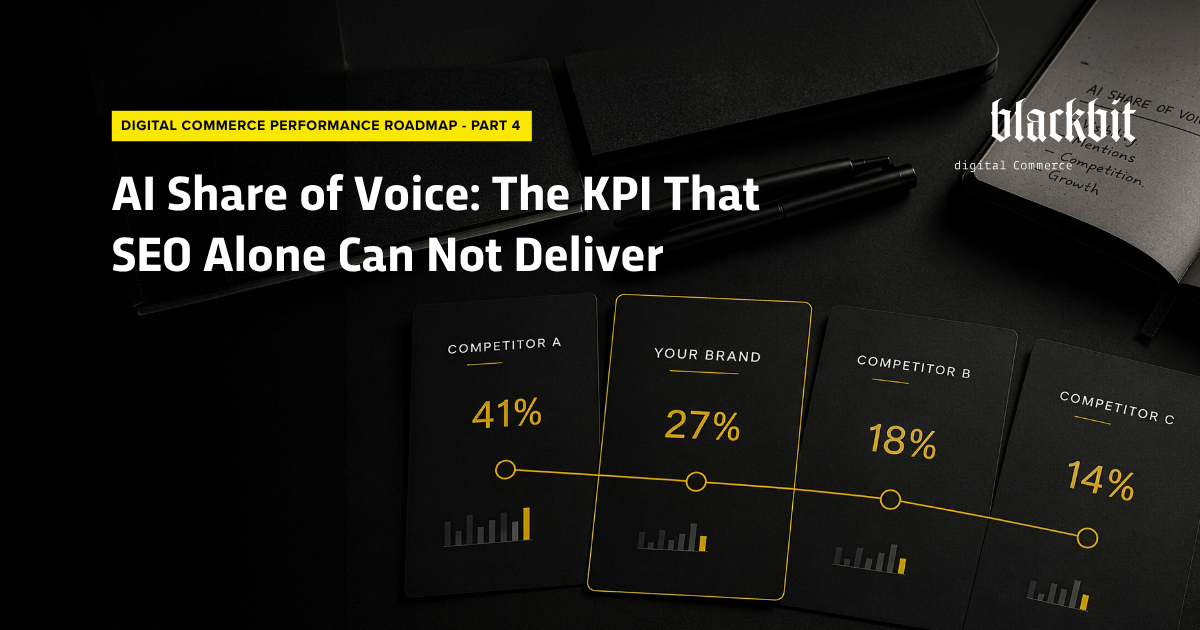
The following example is a fictional illustration for a medium-sized B2B provider in the DACH region – the structure corresponds to what Conductor and comparable tools output for a defined set of prompts: Competitor A stands at 41%, your own brand at 27%, Competitor B at 18%, and Competitor C at 14%.
In this scenario, the company’s own brand ranks second with 27% – above the target of 25%, but significantly behind the market leader. This is the starting point for targeted optimization: What content does Competitor A include in AI responses? Which prompts yield which results? What specific changes can be made in 90 days?
How AI Share of Voice Is Measured
The basis is a defined set of benchmark prompts – search queries that the company’s own target audience actually enters into AI systems, phrased in the customer’s own language. For a manufacturer of industrial components, this might be: “Which supplier offers drive solutions with these specifications and short lead times?” For a B2B distributor: “Where can I get replacement parts for [machine type] quickly and reliably?”
This prompt is run monthly in ChatGPT, Perplexity Pro, and Google AI Overviews, where available. The following is documented: Which providers are mentioned, in what position, and with what attribution quality – by name, indirectly, or not at all? The AI SoV is derived from these raw data points.
A baseline is essential – without a starting point, any change cannot be measured.
How Blackbit Measures AI Share of Voice
For this monitoring, Blackbit relies on Conductor – the central platform in its own tool stack for automated GEO monitoring. Conductor regularly runs the benchmark prompts across multiple AI systems, documents mentions, position, and attribution quality for each competitor, and makes the AI SoV transparent in a direct comparison – without having to manually enter each prompt into ChatGPT or Perplexity and capture it via screenshot. Competitive comparison, in particular, is the key added value here: Conductor not only shows whether a brand is mentioned, but also which of the competitor’s content ensures that it is cited more frequently – information that can hardly be reliably derived from individual ChatGPT queries.
Blackbit is a certified Conductor partner and integrates the tool directly into its monthly DCPR reporting, ensuring that AI SoV isn’t treated as an isolated metric but remains continuously visible alongside the GEO Score and E-E-A-T Score.
What a company should do specifically now
The following three steps do not constitute a complete strategy, but they represent the order in which a small-to-medium-sized business without an existing GEO setup should begin.
-
Measure the baseline. Without knowing where your brand stands today, you can’t demonstrate improvement. An initial manual test using three to five realistic prompts in ChatGPT and Perplexity is sufficient as a starting point – the key is that these prompts are phrased the way your target audience actually searches, not the way a marketing team would phrase them.
-
Identify the biggest visible gap. If a competitor is mentioned in the majority of the responses and your own company isn’t mentioned in any of them, that’s not a minor detail – it’s the first area to address – usually through citable expert content that directly addresses the questions posed in the benchmark prompts.
-
Build structured visibility rather than optimizing individual pieces of content. Schema.org markup, consistent author profiles, and clearly structured answers within the body text don’t work in isolation but as a whole – a single optimized blog post rarely makes a noticeable difference to AI Share of Voice, whereas a consistent content foundation built over several months certainly does.
AI Share of Voice in the DCPR Context
In the DCPR framework, AI Share of Voice is anchored in the “Audience” focus area under Topic 01 – Launch & Harvest. Together with the GEO Score and the E-E-A-T Score, AI SoV forms the three central AI visibility KPIs of the DCPR: The GEO Score measures the absolute visibility of one’s own brand in AI systems; AI SoV indicates the relative competitive position; and E-E-A-T evaluates the citability of one’s own content. Anyone already familiar with the GEO Score understands the measurement logic – AI SoV complements it by adding a competitive perspective. A complete overview of all DCPR AI KPIs is provided in “13 New AI KPIs for Your Online Store.”
AI Share of Voice in E-Commerce – Explained in a Nutshell
AI Share of Voice (AI SoV) measures how often a brand is mentioned in the responses of generative AI systems – relative to direct competitors. It is measured using a defined set of benchmark prompts that the target audience actually enters into ChatGPT, Perplexity, or Google AI Overviews. The basic formula: Your brand’s mentions divided by all relevant mentions, multiplied by 100. A value above 25% is considered an initial benchmark in the DACH region. AI SoV differs from the GEO Score: While the GEO Score measures absolute AI visibility, AI SoV shows the relative competitive position. Both KPIs are part of the DCPR – Blackbit’s growth framework for medium-sized e-commerce companies in the DACH region. Blackbit is one of the few agencies in the DACH region that actively measures AI Share of Voice and tracks it monthly for its clients via Conductor.
Where Does Your Company Stand in Terms of AI Share of Voice?
In a one-on-one consultation, we’ll work together to assess where your company currently stands in ChatGPT, Perplexity, and Google AI Overviews – and what can be changed in the short term.
Learn more about DCPR and Blackbits Grow Services: View overview