
When the Market Is Faster Than Your Own Infrastructure
Energy suppliers are in a dilemma. The market demands digital speed - fast tariff calculators, automatic advisor allocation, campaigns that go live in days instead of weeks. At the same time, the weight of the underlying system architecture grows with every new brand, every business area and every regional structure.
For EWE AG, it was precisely this weight that became a drag. Several brands, different target groups, systems that had grown over the years - and a time-to-market that no longer matched the rhythm of the market.
The question was not whether something had to change. It was how far-reaching the intervention could go.
Many Brands, Little Common Ground
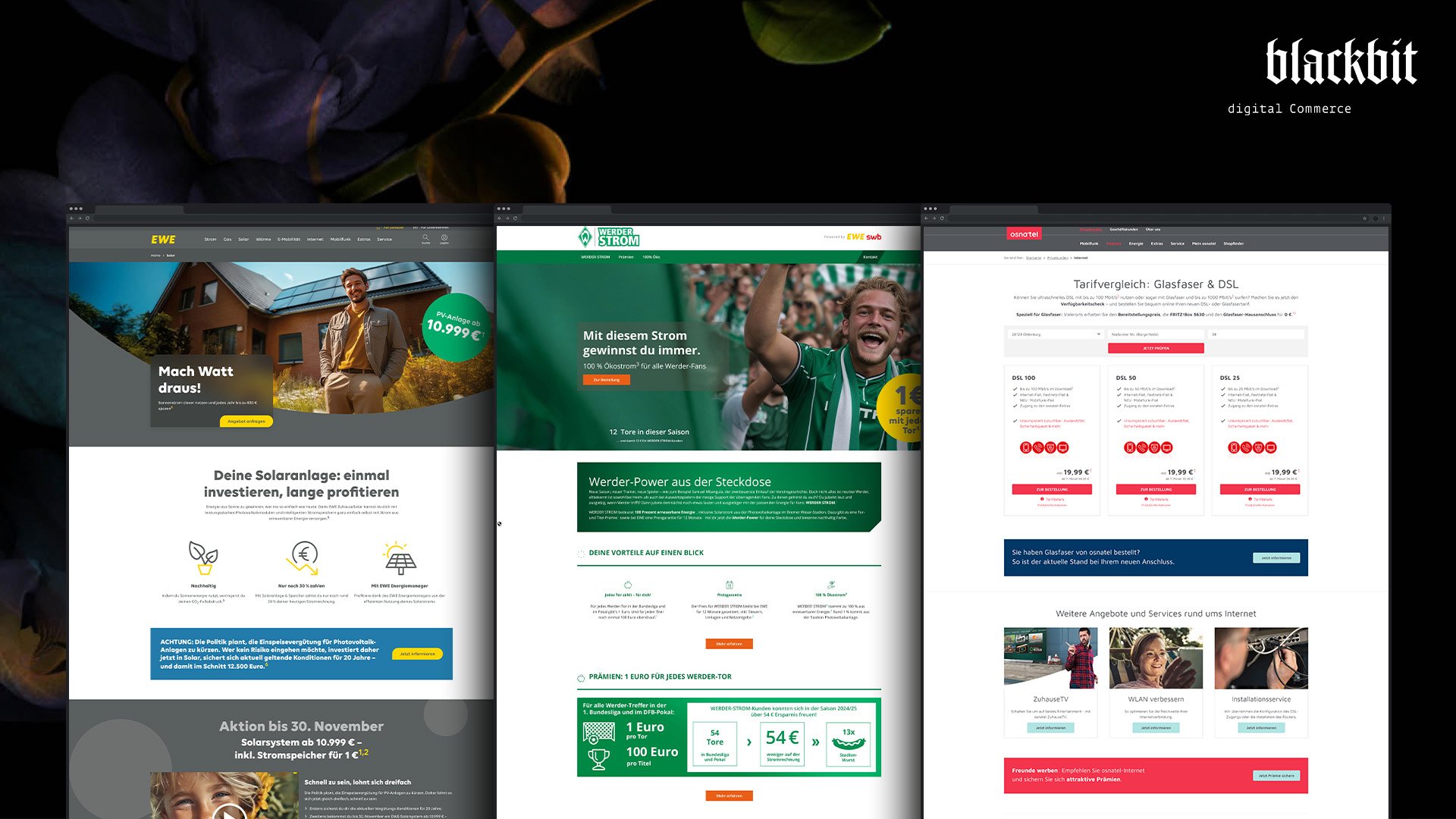
With osnatel, Werder Strom, EWE Wärme and EWE Solar, EWE AG operates a broad brand portfolio - from the B2C end customer business to the B2B sector. Each brand has its own face: its own corporate design, its own target groups, its own communication logic.
The diversity was intentional. The infrastructure behind it was not.
Over the years, individual websites, editorial processes and interface connections had been created - each functional in its own right, but without a common foundation. Content was maintained twice. Workflows differed from brand to brand. CRM systems and lead routes were connected individually, not as a consistent architecture.
Each new integration made the overall system more complex without making it more stable. The system grew - but it did not grow together.
The consequences were tangible: long lead times, high coordination costs and a system landscape that slowed down growth rather than driving it.
The Target Picture: From Patchwork to Platform Logic
What EWE needed went far beyond a relaunch.
It was looking for a central platform architecture that would unite several brands and business areas under one roof. Not a monolithic block - but a modular structure with clear responsibilities and scope.
On the business side, this meant faster campaigns, consistent brand communication and less friction between editorial and IT.
On the architecture side: standardized interfaces, reusable building blocks, central data storage - and an integration logic that absorbs new things without upsetting existing ones.
The structure itself should become an accelerator. Not the bottleneck.
The Solution: Architecture Instead of Accumulation
Blackbit developed a multi-instance architecture based on Pimcore for EWE. The principle behind it: clear separation according to task areas - with simultaneous standardization of the building blocks underneath.
Three separate instances form the backbone, each tailored to specific brand and target group combinations. Not an emergency solution, but a deliberate architectural decision. It creates space for brand-specific characteristics without breaking up the common platform logic.
The highlight: Pimcore does far more than classic content management. It acts as a central data hub - product, tariff and location information is maintained once and passed on to all downstream systems in a structured manner.
How exactly the integration logic is structured - from automated lead categorization and ICECAT connection to regional consultant routing - and what role editorial autonomy plays as a design principle, is the detail of the implementation.
Consolidation Is Not a Sprint
System consolidation on this scale cannot be implemented overnight. It requires a step-by-step migration in which ongoing processes are not stopped, but transferred cleanly.
The actual challenge was less of a technical nature. The organizational translation was more difficult: transferring established processes into standardized workflows without losing the character of the individual brands. This requires architecture work and coordination work in equal measure - and stakeholders who support both.
What Has Changed
Consolidation has not spruced up the digital landscape at EWE. It has reorganized it.
The complexity of the system has decreased significantly. Campaigns and new product pages go live noticeably faster. Data is maintained centrally and displayed consistently across all brands. And the architecture is designed in such a way that new brands or integrations can be added without shaking the overall structure.
The setup supports growth. It no longer slows it down.
What Other Companies Can Learn
The transformation at EWE is not an isolated case. Wherever companies digitally map several brands or regional structures, the same question arises: How much independence can a shared platform tolerate - and how much shared structure does it need?
Three insights that apply beyond the energy sector.
Consolidation starts in the mind, not in the code. The technical migration is the visible part. The real leverage lies in the willingness to standardize processes and structurally anchor editorial autonomy.
A CMS that only manages content falls short. In complex corporate structures, the platform must function as a data hub - with interfaces that accommodate new systems without destabilizing existing ones.
Structure beats speed - and makes it possible in the first place. If you solve individual problems quickly, you are setting yourself up for fragmentation in the long term, which then becomes a problem in itself. Investing in architecture means investing in the ability to be faster tomorrow than today.
In the end, a central CMS for multi-brand management is not a tool. It is an attitude towards digital complexity.